Matsuo Lab (UTokyo), PKSHA, and Anthropic Partner to Build the "Japan AI Index" to Visualize AI's Impact on Employment, Industry, the Economy, and Education
others
Integrating real-world Claude usage with domestic economic data to visualize the impact of AI and support evidence-based decision-making
The Matsuo-Iwasawa Laboratory at the University of Tokyo’s Graduate School of Engineering, Matsuo-Iwasawa Laboratory (Principal Investigator: Professor Yutaka Matsuo; hereinafter "Matsuo Laboratory") announces a collaborative partnership with PKSHA Technology Inc. (Head Office: Bunkyo-ku, Tokyo; Representative Director: Katsuya Uenoyama; hereinafter "PKSHA") and US-based Anthropic, PBC (hereinafter "Anthropic").Together, these organizations are developing the "Japan AI Index" (*1), a dedicated platform for the continuous observation and analysis of the societal impact of generative AI within Japan.
As the decline in Japan's working-age population accelerates, enhancing productivity through AI is an imperative challenge to maintain the nation's industrial competitiveness. Simultaneously, fostering the appropriate deployment of AI requires an evidence-based understanding of technological diffusion and its subsequent effects on labor dynamics, employment, and industry. The Japan AI Index addresses this critical need by serving as an advanced, localized observation platform. It uniquely integrates the academic neutrality of a university research laboratory, the empirical large language model (LLM) usage statistics of a developer, and the practical implementation expertise of an enterprise partner.
Background to the Japan AI Index: Building a Foundation for Fact-Based Debate
The rapid proliferation of generative AI accelerates its adoption across all industries and occupations. To maximize the benefits of this technology, it is urgently necessary to objectively assess its impact on labor, employment, and industrial sectors, subsequently integrating these insights into on-the-ground management and human resource development. The Japanese government established the AI Strategy Headquarters and an expert panel in 2025, setting out a policy to make Japan "the country where AI is easiest to develop and use in the world" (*2).
However, no empirical observation platform yet exists in Japan that can demonstrate with data the true impact of AI on society, given the nation’s distinctive industrial structure and employment practices. Conversely, institutional efforts to address this challenge are already underway in the United States: Anthropic, with due consideration for user privacy, publishes the "Anthropic Economic Index" (*3), which analyzes the actual deployment of AI at the specific occupation and task levels based on anonymized Claude usage data.
Such a tracking platform is essential not only for objectively quantifying the state of AI utilization in Japan, but also for evaluating its broader implications for Japanese society. By cross-referencing user metrics with national industrial and employment statistics, the Japan AI Index refines this localized knowledge, establishing an observational framework unique to Japan.
Overview of the Japan AI Index: Visualizing AI's impact by Industry, Occupation, and Task by Combining LLM Usage Statistics with Domestic Economic Data
The Japan AI Index is an observation platform that integrates two streams of data, and it is distinguished by uniting academic, technological, and industrial perspectives into a single framework. The Matsuo Laboratory leads the neutral analytical design, Anthropic provides the aggregated and anonymized Claude usage statistics utilized for its Economic Index as the foundational data for analysis, and PKSHA contributes its practical AI implementation expertise in industry, taking responsibility for nurturing the Index into a useful de facto standard.
1.Statistical data on LLM usage, including the Anthropic Economic Index.
2.Official statistics and survey data on economic activity, employment, and education in Japan, including industry-level productivity data, occupational data such as Japan O*NET, employment headcount data, etc.
By cross-referencing these data streams, the platform continuously conducts and publishes the following analyses based on rigorous academic methodologies:
- Visualization of the progress of AI adoption across Japan's industrial domains
- Analysis of shifting roles between tasks handled by AI and those managed by personnel
- Examination of the relationship between the degree of AI adoption and GDP, employment, and wages
- Detection of productivity changes by specific industry and occupation
- Identification of implications for the talent and skills required in the AI era
The University of Tokyo takes the lead in publishing these analytical results via an interactive dashboard and an annual report, disseminating them as an observational framework to inform discussions across policy, industry, and education. This platform supports evidence-based decision-making for corporate AI investment, organizational and operational design, and curriculum development at universities and educational institutions.
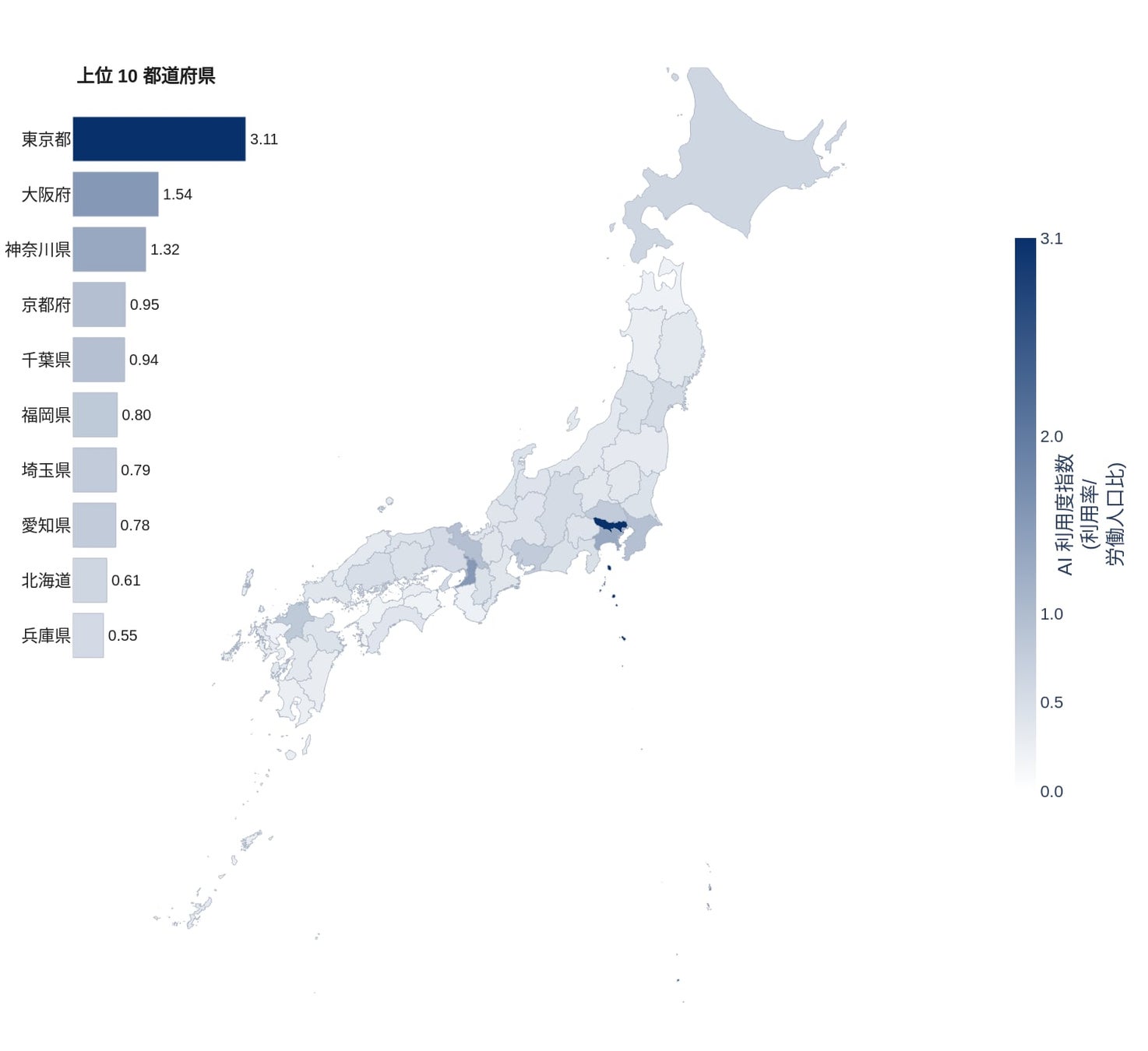
Visualization of the degree of AI adoption per working-age population, estimated from Claude usage share. Usage is concentrated in metropolitan areas such as Tokyo, Osaka, and Kanagawa. (Based on Anthropic Economic Index data as of February 2026.)
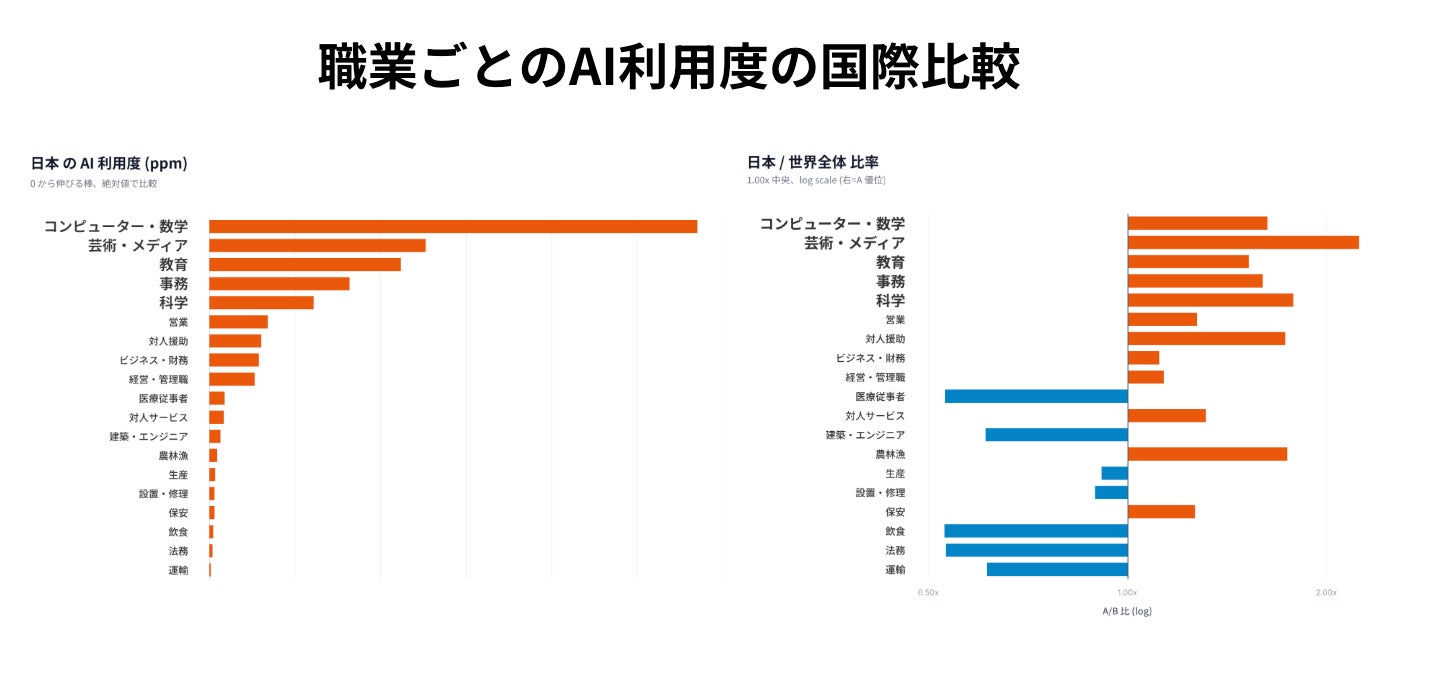
International comparison of AI usage by occupation. Even in "Computer & Mathematics," the category where adoption is most advanced, Japanese usage stands at 40% of the U.S. level. (Based on Anthropic Economic Index data as of February 2026.)
Roles of Each Institution
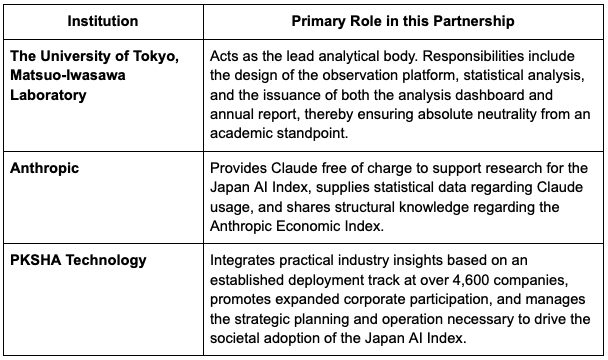
The specific form of collaboration is to be finalized following subsequent discussions among the participating parties.
Future Outlook: Establishing a Common Language for AI Use in Japan and Promoting Human–AI Collaboration
Moving forward, the initial report and dashboard are scheduled for publication around the autumn of fiscal 2026. Thereafter, while simultaneously expanding the analytical scope of analysis and recruiting participating companies (*4), the partners will provide regular updates through annual reports, quarterly updates, and related communication channels.
Through this project, the Matsuo Laboratory of the University of Tokyo, PKSHA, and Anthropic will establish an environment that visualizes, through objective data, how AI transforms labor dynamics across industrial sectors. This framework will shift discussions within policy, management, and human resource development toward an entirely evidence-based approach. To realize a prosperous society where AI extends human capabilities and broadens opportunities, the partners aim to develop this underlying data infrastructure, positioning the Japan AI Index as a foundational, widely referenced observation platform.
Comments from Representatives of Each Institution
Professor Yutaka Matsuo, Matsuo-Iwasawa Laboratory, Graduate School of Engineering, The University of Tokyo
"Amid the rapid spread of generative AI, Japan still lacks a foundation that can demonstrate with data what AI is actually changing. Establishing a framework in which we can debate based on the empirical realities, rather than on intuition or impressions, is, I believe, what is most needed right now.
The Japan AI Index serves as a foundation for continuously grasping how AI is permeates each industry and occupation by cross-referencing Claude usage statistics with domestic employment and industry data. Policy debate, corporate management decisions, and the direction of human resource development cannot be advanced on solid ground without reliable data. I hope this initiative will help add a firm evidence base to the discussion of AI utilization in Japanese society."
Katsuya Uenoyama, Representative Director, PKSHA Technology Inc.
"Debate over AI tends to swing between two extremes: the advocacy that 'we simply must adopt it,' and an excessive anxiety that 'our jobs will be taken away.' What matters, however, is first to understand, through objective data, what AI introduces to society. Second, rather than superficially imitating the success stories of leading AI nations, Japan needs to consider a form of coexistence with AI that is rooted in its own industrial structure, labor practices, and core values. The Japan AI Index aims to serve as the social infrastructure for that purpose.
First, we identify the facts, then we derive implications from them, and finally, we discuss what an AI society uniquely suited to Japan should look like, thereby connecting this understanding to improved policy and corporate decision-making. We want to construct that foundation through industry-academia collaboration."
Hidetoshi Tojo, President & Representative Executive Officer, Anthropic Japan G.K.
"Anthropic is an AI safety research company whose mission is to build safe and beneficial AI. To fulfill that mission, we have published the 'Anthropic Economic Index' in the United States. This index analyzes the actual state of AI utilization at the occupation and task level based on anonymized Claude usage data, and it serves as a reference point for a wide range of decisions, spanning corporate AI strategy, human resource development, and policy debate. The Japan AI Index represents an effort to deepen this knowledge in line with Japan's distinctive industrial structure and employment practices. Together with the Matsuo Laboratory, which ensures academic neutrality, and PKSHA, the hub for industrial implementation, we will contribute to building an observation platform that supports responsible AI use in Japanese society and helps ensure that AI broadens the possibilities of each individual."
Footnotes
1: Tentative name as of June 2026.
2: Source: Cabinet Office, Basic Plan for Artificial Intelligence (December 23, 2025).
https://www8.cao.go.jp/cstp/ai/ai_plan/aiplan_20251223.pdf
3: "Anthropic Economic Index" https://www.anthropic.com/economic-index
4: Participating companies: companies that bring together their knowledge to discuss and examine the future economy, work, education, and related matters in the "After AI" era.
About Each Institution
The University of Tokyo — Matsuo-Iwasawa Laboratory
Driven by the vision of "creating intelligence," the Matsuo-Iwasawa Laboratory advances research on deep learning, focusing specifically on world models, robotics, large language models, and Brain × AI. Additionally, the Laboratory emphasizes translating its basic research into societal benefits through lectures, joint corporate research initiatives, and strategic support for nurturing student entrepreneurs.
URL: https://weblab.t.u-tokyo.ac.jp/
About PKSHA Technology Inc.
PKSHA, with the mission of "shaping the software of the future," offers a range of AI addressing social issues.These are deployed as
Company Name:PKSHA Technology Inc.
Location:Hongo Segawa Building 4F, 2-35-10 Hongo, Bunkyo-ku, Tokyo
Representative:Representative Director UENOYAMA Katsuya
URL:https://www.pkshatech.com/